
Montgomery County Arrest Records and Court Charges
Montgomery County arrest records begin with law enforcement. The Montgomery County Sheriff's Office is the local law-enforcement contact listed at 1 Court Street, Suite 4, Mount Sterling, Kentucky 40353, with phone 859-498-8704. The sheriff's site describes the office as a full-service law-enforcement agency and provides a services page for report copies, vehicle inspections, and direct office contact. Research did not locate an official Montgomery County app-only arrest search or online jail roster.
The court charge record begins when a citation, complaint, warrant, indictment, or other charging paper enters the court system. That charge record is not the same thing as a booking record. Booking and custody questions may require the sheriff, the jail, KOOL, or VINE, while the court charge record is verified through KYeCourts, docket search, and the Circuit Court Clerk. The full case file and outcome are explained in Montgomery County criminal court records.
Find Montgomery County Arrest Records and Charges
The search path depends on what the user needs. For custody or recent booking status, official research points to the Sheriff's Office and state custody tools because a clean official Montgomery County jail roster was not located. For court charges after arrest, use Kentucky court case tools and the local clerk. KYeCourts guest access can show public case information, while docket search can show court settings when the county, division, and date are known.
- For arrest or report-copy questions, contact the Montgomery County Sheriff's Office or use the sheriff's official services and contact pages.
- For charges filed in court, use KYeCourts Public Court Records guest access and search public case information where available.
- For hearing dates after arrest, use the Kentucky public docket search and choose Montgomery County plus the correct division.
- For fines, fees, or costs tied to an eligible case, use KYeCourts Easy Pay or ask the clerk about payment options.
- For official copies, older court files, or unclear charge status, call the Circuit Court Clerk at 859-498-5966 or 859-498-5991.
Easy Pay is one access channel for some court financial obligations after a charge enters the court system. The manifest capture from KYeCourts Easy Pay case and payment search shows the official payment search source.
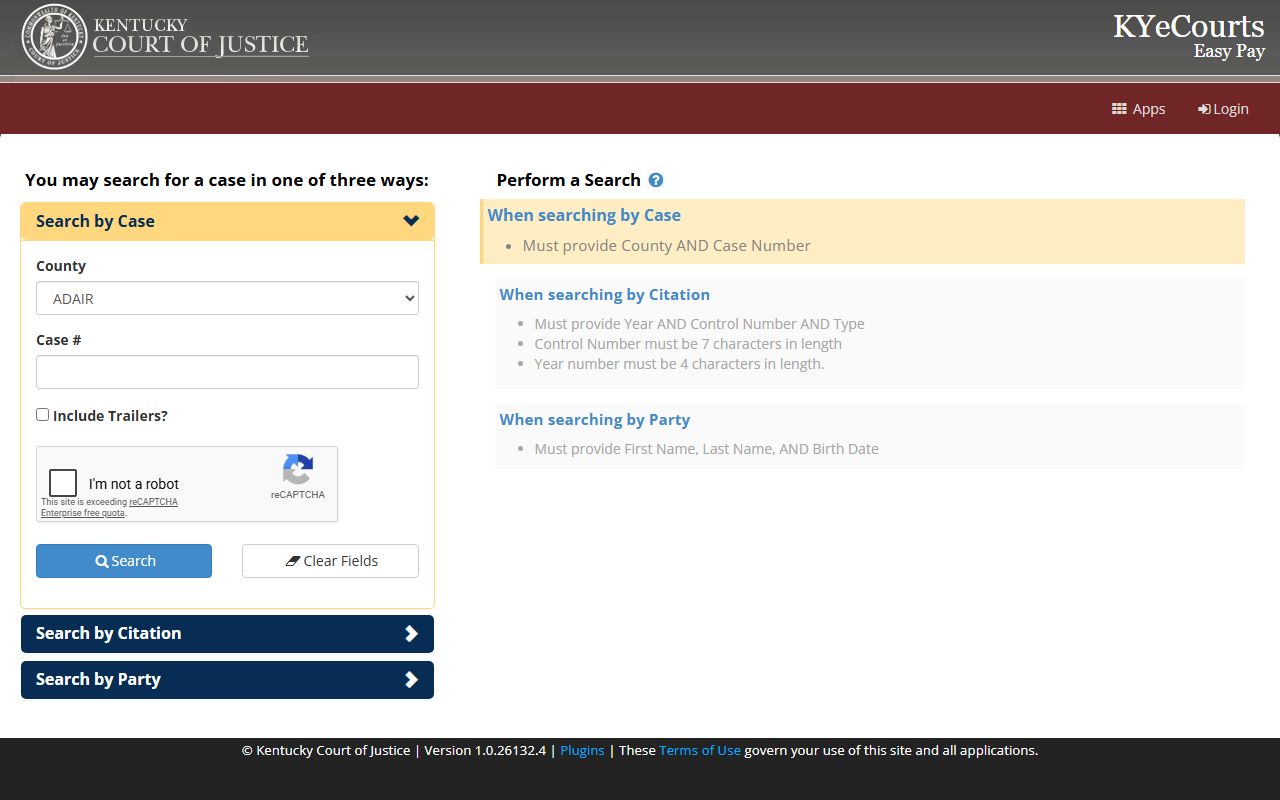
Payment eligibility does not mean every charge can be resolved online, so appearance requirements should be checked before relying on ePay.
Charges After Arrest
Charges after arrest can come from several document types. Kentucky materials in the research file describe complaints, citations, indictments, bond information, arraignment entries, motions, orders, trial entries, sentencing, and disposition as parts of criminal records. A felony may begin in District Court for arraignment or probable cause, then move to Circuit Court after indictment or transfer. A misdemeanor usually remains in District Court.
| Document | Who Creates It | Common Use | What It Starts |
|---|---|---|---|
| Complaint | Law enforcement or prosecutor | Misdemeanor, violation, or preliminary criminal allegation | A District Court criminal case or early felony stage |
| Information | Prosecutor, when authorized by court procedure | Formal prosecutor-filed charge where permitted | A criminal charge without using the local grand-jury indictment route |
| Indictment | Grand jury | Felony prosecution in Circuit Court | A formal felony charge in Circuit Court |
Citations and warrant-related entries can also create court events in Montgomery County, especially in traffic, misdemeanor, and failure-to-appear settings. The local research directly documents complaints, citations, indictments, warrants, and docket activity; information is included as a charging-document category, but not as a Montgomery-specific sample filing.
Who Files Montgomery County Charges
Prosecution roles in Kentucky differ from states that use District Attorney titles. Felonies and many Circuit Court criminal matters are handled by the Commonwealth's Attorney. Montgomery County is in the 21st Judicial Circuit with Bath, Menifee, and Rowan Counties, and research identifies Ashton McKenzie as Commonwealth's Attorney for that circuit. The Montgomery County Fiscal Court lists the Commonwealth's Attorney phone as 859-498-0911.
The County Attorney handles many lower-level criminal, traffic, juvenile, child support, and county legal functions depending on the matter. The Fiscal Court lists the County Attorney phone as 859-498-8713, and a local listing identifies the office at 1 Court Street Suite 1, Mt. Sterling, KY 40353, with fax 859-498-8714. Because attorney names can change, prosecutor identity should be verified through official state or county channels before using it for a filing or appearance.
Federal prosecution is separate. The manifest capture from U.S. Attorney's Office for the Eastern District of Kentucky shows the federal prosecutor source, which is not the same as Montgomery County state charges.
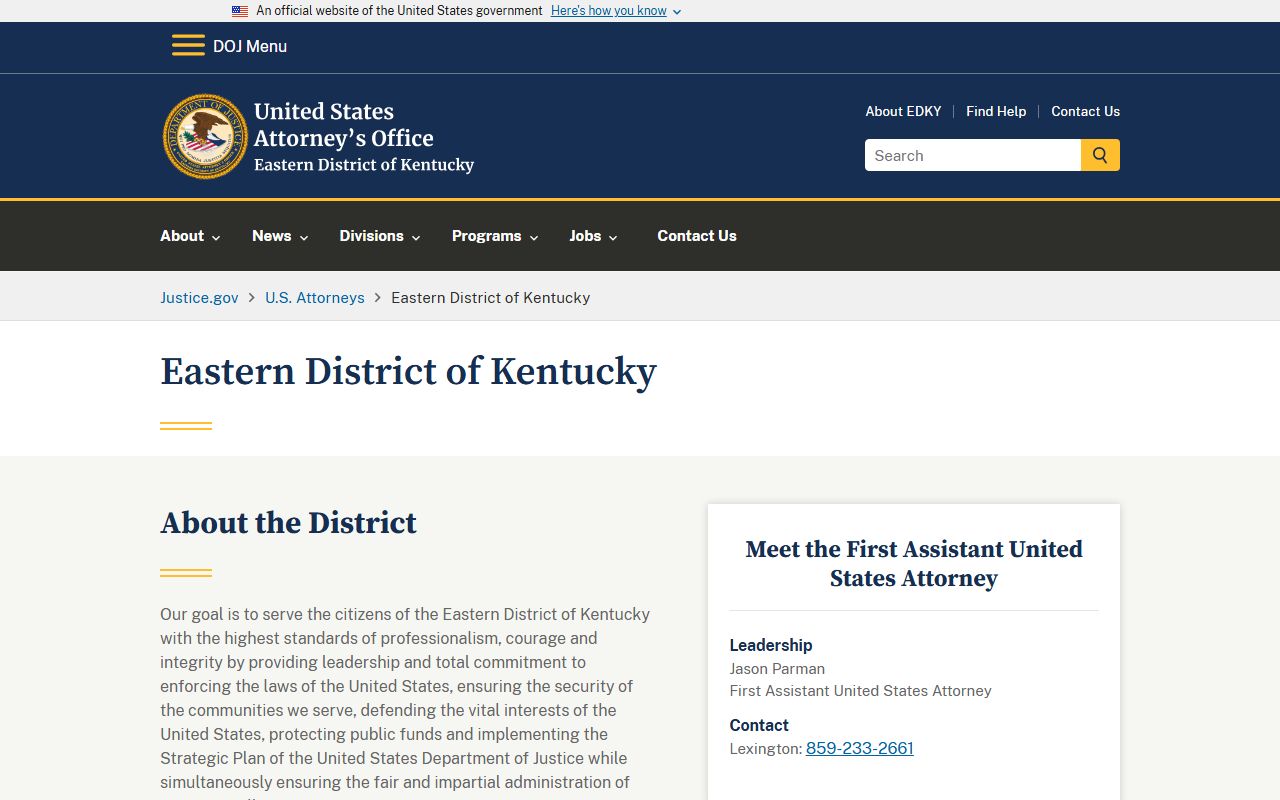
Most local arrest-to-charge questions are state or county matters, while federal charges are searched through federal court and prosecutor systems.
Montgomery County Charge Status
Charge status can change as the prosecutor reviews the facts, the defense responds, and the judge enters orders. A single arrest can produce more than one charge. One charge may be dismissed while another is amended, reduced, or resolved by plea. The status line should be read with the case docket, disposition, and sentence instead of as a stand-alone label.
| Status | What It Means |
|---|---|
| Pending | The charge remains active and has not reached final disposition. |
| Amended | The charge text, statute, level, or facts were changed by court action or prosecutor decision. |
| Reduced | The charge was lowered to a less serious offense or level. |
| Dismissed | The court record shows that charge or case was dismissed, with final effect depending on the order. |
| Transferred | The case or charge moved between court levels, such as District Court to Circuit Court. |
| Disposed | The court has entered an outcome, such as plea, verdict, dismissal, or other final action. |
Charges vs Convictions
Arrest records and court charge records should never be read as convictions by default. A charge is an allegation or formal accusation. A conviction is a final result after a guilty plea, verdict, or qualifying disposition. Montgomery County court records can show charges that were later dismissed, reduced, amended, transferred, or expunged.
| Point | Charge | Conviction |
|---|---|---|
| Meaning | An accusation filed or tracked in court. | A guilty outcome by plea, verdict, or qualifying final action. |
| Timing | Appears near arrest, citation, complaint, warrant, or indictment stage. | Appears after plea, trial, or final court action. |
| Can change | Yes, it can be amended, reduced, dismissed, or transferred. | It may later be appealed, vacated, or expunged only if law allows. |
| How to read | Review the charge line and status. | Review disposition and sentencing entries. |
Bond and Court Dates After Arrest
Court charge records after arrest can include bond, release conditions, court date, judge, division, and failure-to-appear history when those details are public. The Montgomery County court page lists local payment options for court business: cash, money order, check held 10 days to clear the bank, credit or debit cards with a fee, and ePay where eligible. Bond and payment questions should be checked with the clerk or the issuing court because online systems can lag.
Local docket timing matters. District Court lists misdemeanor and felony arraignments on Monday and Thursday at 9:30 a.m. Traffic is Monday and Thursday at 9 a.m. Circuit Court criminal motion timing differs by division: Division 1 criminal motion day is fourth Friday at 10:30 a.m., with grand jury at 2 p.m., while Division 2 criminal motion day is second Friday at 9 a.m.
Note: If a charge follows a missed court date, verify warrant, bond, and recall options directly with the clerk or sheriff.
Statewide Criminal History Lookups
A Montgomery County court charge lookup is not the same as a statewide criminal-history report. KCOJ directs users who need official criminal-record reports to the AOC background-check process. KCOJ expungement resources also explain certification steps for eligible felony, misdemeanor, violation, and traffic matters. Those statewide tools are useful when a person needs more than the local case docket or when an expungement question affects what remains public.
For custody after an arrest, Kentucky Online Offender Lookup and Kentucky VINE can help with sentenced or custody-notification information, but they are not guaranteed current booking rosters for every local pretrial inmate. Research found no official Montgomery County sheriff or Mount Sterling police mobile app with app-only inmate, warrant, or arrest search features.
Restricted Montgomery County Charge Records
Public access limits apply to arrest and charge information. Juvenile records are restricted under Kentucky juvenile-record rules. Sealed and expunged matters should not appear like ordinary public cases. Adoption, mental-health, domestic-violence safety details, Social Security numbers, financial-account numbers, minor names, and safety-sensitive addresses can be closed or redacted. KRS 61.878 is one of the Kentucky open-records exemption statutes relevant to sensitive records.
| Point | Sealed Charge Record | Expunged Charge Record |
|---|---|---|
| Public access | Hidden from ordinary public inspection by court order or rule. | Removed from ordinary public search when the expungement order applies. |
| Record status | The record exists, but access is limited. | The case or charge can be vacated, dismissed, removed, or deleted as statute permits. |
| Kentucky path | Depends on the case type and court order. | Uses eligibility rules such as KRS 431.073 or KRS 431.078. |
Expungement can change public access to charge records. KRS 431.073 covers eligible felony conviction vacatur and expungement, while KRS 431.078 covers eligible misdemeanor, violation, traffic-infraction convictions, and dismissed or amended charges. If a record is sealed or expunged, ordinary online searches may not show it even when older paper or memory suggests it once existed.